2026 Guide: Registration, Food Licensing, Foreign Chefs and Guangzhou Dining Districts
Introduction
China's foodservice market offers opportunities for international cuisines, from Italian restaurants and Turkish grills to Indian dining and specialty cafés. For overseas entrepreneurs, opening a restaurant is not simply a matter of registering a company and renting premises. The food operation must satisfy licensing, site, ventilation and other applicable requirements; foreign staff need appropriate work authorization; and the location must attract customers who are likely to pay for the concept. This guide uses Guangzhou as a practical example.
1. Registering a Restaurant Business in China
Foreign investors can generally establish a Chinese company to operate an ordinary restaurant, subject to foreign-investment and other applicable rules. A wholly foreign-owned or jointly owned limited liability company is a common structure. Ordinary restaurant operations do not generally require a Chinese shareholder.
Before applying, establish the proposed Chinese company name, shareholders, registered capital, legal representative, registered address, business scope and Articles of Association. Obtaining a business license alone does not authorize foodservice activities that require a Food Business License.
Verify the premises before committing to a long lease or major renovation: an address acceptable for business registration may still be unsuitable for a restaurant because of kitchen layout, exhaust, drainage, fire-safety or environmental restrictions.
| Registration item | Main requirement |
|---|---|
| Company name | Compliant registered Chinese name |
| Shareholder | Foreign individual or overseas company; supporting identification |
| Registered capital | Appropriate for fit-out, staffing and operations |
| Legal representative | Person meeting the applicable company-law conditions |
| Premises | Address meeting both registration and restaurant-operation requirements |
| Business scope | Catering and other activities actually conducted |
| Articles of Association | Ownership, capital and governance provisions |
2. Food Business License: Does Restaurant Size Matter?
A Food Business License (食品经营许可证) is generally the key sector-specific authorization for an ordinary restaurant in China. Guangdong's applicable rules classify catering establishments by the usable area of their operating premises, but area alone does not determine approval. Food preparation methods, operating items and food-safety risks also matter.
2.1 Typical size categories
The following categories summarize Guangdong's restaurant classifications. Boundary cases and usable-floor-area calculations should be confirmed with the local licensing authority.
| Category | Usable area | Typical format |
|---|---|---|
| Small catering establishment | Up to 50 m² | Snacks, compact takeaway or light dining |
| Small restaurant | 50–200 m² | Small casual or international restaurant |
| Medium restaurant | 200–1,000 m² | Medium-size dine-in restaurant |
| Large restaurant | Over 1,000 m² | Large-format restaurant or banquet operation |
2.2 What inspectors assess
Requirements typically involve separation of food handling and cleaning areas; safe storage and refrigerated facilities; washing, disinfection and utensil storage; drainage, pest prevention and waste handling; prevention of cross-contamination; and food safety and worker health management. Some raw, cold-prepared or other higher-risk foods may trigger more specific conditions.
2.3 Ventilation and environmental restrictions in Guangzhou
Cooking involving frying, stir-frying, grilling or similar methods may produce fumes and odors. Guangzhou restricts new or altered catering projects producing cooking fumes, odors or exhaust gases in certain residential buildings, mixed-use buildings without dedicated exhaust ducts, and commercial floors adjoining residential floors. Some beverage, dessert and reheating operations may fall within specific exceptions. Confirm ventilation, waste-water handling, fire safety and property rules before signing.
3. Work Permits for Foreign Investors and Chefs
Owning shares in a restaurant does not automatically authorize a foreign national to work in China. An overseas shareholder who only holds an investment position is not in the same position as someone managing daily restaurant operations on site. A foreign investor who plans to work in Guangzhou should assess the requirements for a foreigner's work permit and the appropriate residence status.
A restaurant hiring an overseas chef—such as an Italian chef for an Italian restaurant or a Turkish chef for a Turkish restaurant—must assess the applicant against the applicable work-permit standards. Relevant evidence may include a passport, verified work experience, qualifications where required, a no-criminal-record document, a health examination, an employment contract, employer registration details, and other documents required for that application. A chef's nationality or cuisine specialty does not guarantee approval.
| Document | Purpose |
|---|---|
| Passport | Identity |
| Work experience evidence | Supports relevant professional experience |
| Qualification/skill documentation (if applicable) | Supports eligibility assessment |
| Criminal record certificate | Work-permit application |
| Health examination | Health requirements |
| Employment agreement | Genuine hiring relationship |
| Employer business license | Employer identity |
| Other documents | As requested for the application category |
4. Guangzhou: Foot Traffic and Retail Rent
The strongest foot traffic does not necessarily yield the best restaurant site. What matters is whether passing visitors match the intended clientele, price point and meal occasion. Tianhe Road has large shopping and family traffic; Beijing Road attracts tourists and shoppers; Zhujiang New Town combines office, residential and business dining; and Panyu Wanbo combines mall and local household demand.
Retail rents vary sharply by district, frontage, floor and property. A CBRE report on Guangzhou prime retail premises in 2025 cited an average first-floor sample rent around RMB 20.9 per square meter per day, or about RMB 627 per square meter over 30 days. This is a prime retail sample, not a citywide average restaurant rent or a quote for any particular unit. Ask landlords for current terms, including management charges, rent escalation and fit-out periods.
| Area | Main customer catchment | Formats to investigate |
|---|---|---|
| Tianhe Road | Shopping, offices, families | Brand dining, cafés, casual concepts |
| Beijing Road | Tourists, shopping, young consumers | Casual international food, snacks |
| Zhujiang New Town | Office and residential trade | International dining and business lunches |
| Panyu Wanbo | Malls, offices and households | Family-oriented restaurants |
5. Guangzhou’s Distinctive Dining Districts, Expat Networks and Trade-Fair Visitors
Guangzhou offers several kinds of international dining catchments. Some are established cultural food streets, while others are exhibition-related areas with fluctuating business visitors. Historic foreign trade communities should not be mistaken for current statistics on foreign residents.
| Dining district | Distinctive characteristics |
|---|---|
| Xiaobei / Baohan Street | International trade history; Middle Eastern, Turkish, African and halal food |
| Taojin / Jianshe 6th Road | International dining, cafés, hotel trade |
| Zhujiang New Town / Xingsheng Road | Business dining and international restaurants |
| Shamian / Yongqingfang | Heritage tourism and atmospheric cafés |
| Pazhou / Canton Fair | Event-driven international business visitors |
| Party Pier / Zhujiang Pati | Riverside terraces, repurposed brewery and nightlife |
5.1 Xiaobei and Baohan Street
The Xiaobei–Baohan Street and Huanshi Middle Road area has a history of international trading communities and diverse food offerings, including Middle Eastern, Turkish, African and halal cuisines. It is worth investigating for restaurants serving such audiences, but the current customer mix must be checked street by street.
5.2 Taojin and Jianshe 6th Road
Taojin, Jianshe 6th Road and Huanshi East have a longstanding mix of international restaurants, cafés, bars, hotels and business services. Restaurant operators can study Western, international casual dining and evening concepts here, while checking existing competition and lease costs.
5.3 Zhujiang New Town and Xingsheng Road
Zhujiang New Town combines office towers, housing, shopping and business dining. Xingsheng Road and neighboring blocks feature a variety of international restaurants and social dining venues. The area warrants investigation for full-service international cuisines, business lunches and dinner trade.
5.4 Shamian and Yongqingfang
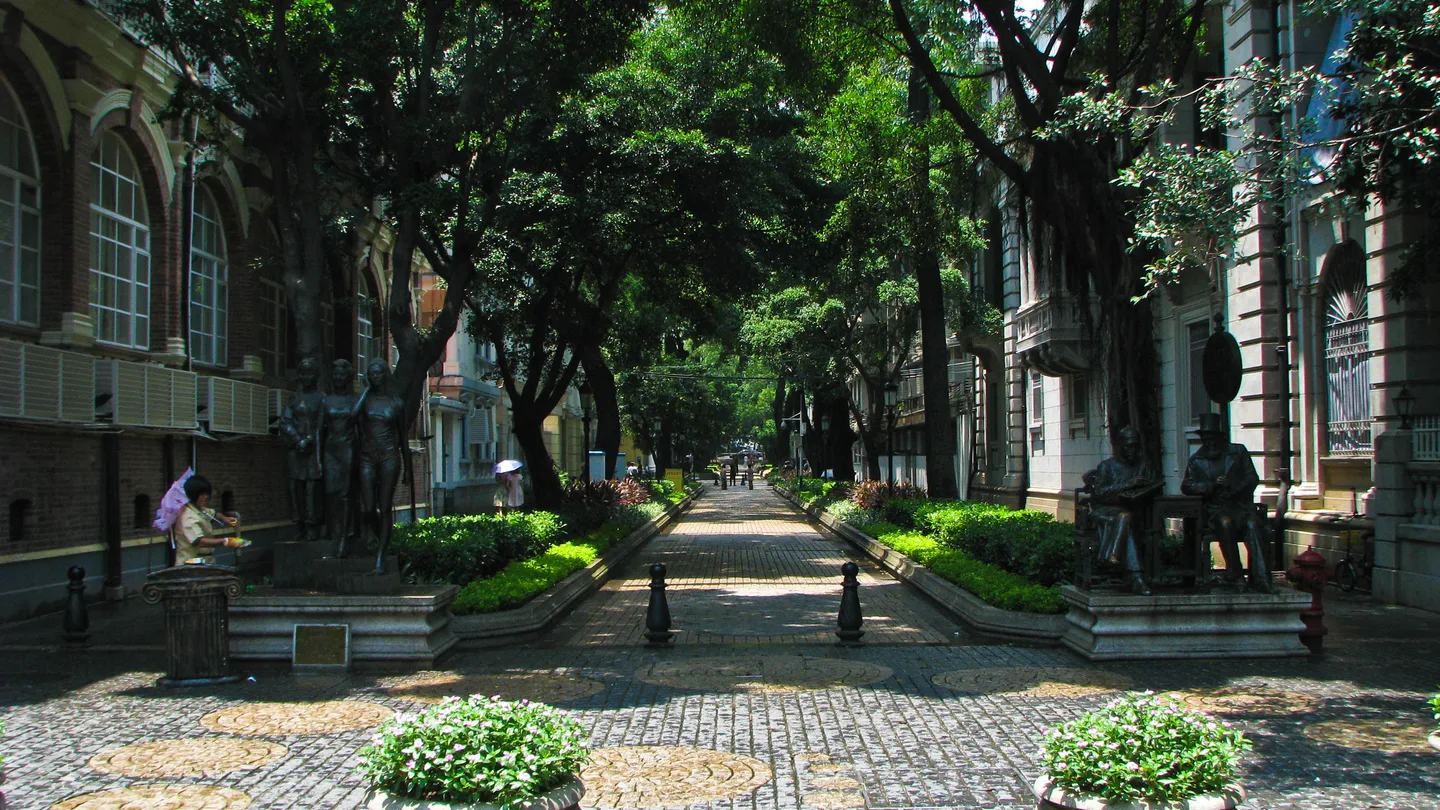
Shamian and Yongqingfang offer historic architecture and tourism-oriented experiences. They can suit distinctive restaurants, specialty cafés and desserts that benefit from atmosphere and design. Heritage-protection and fit-out requirements may be important.
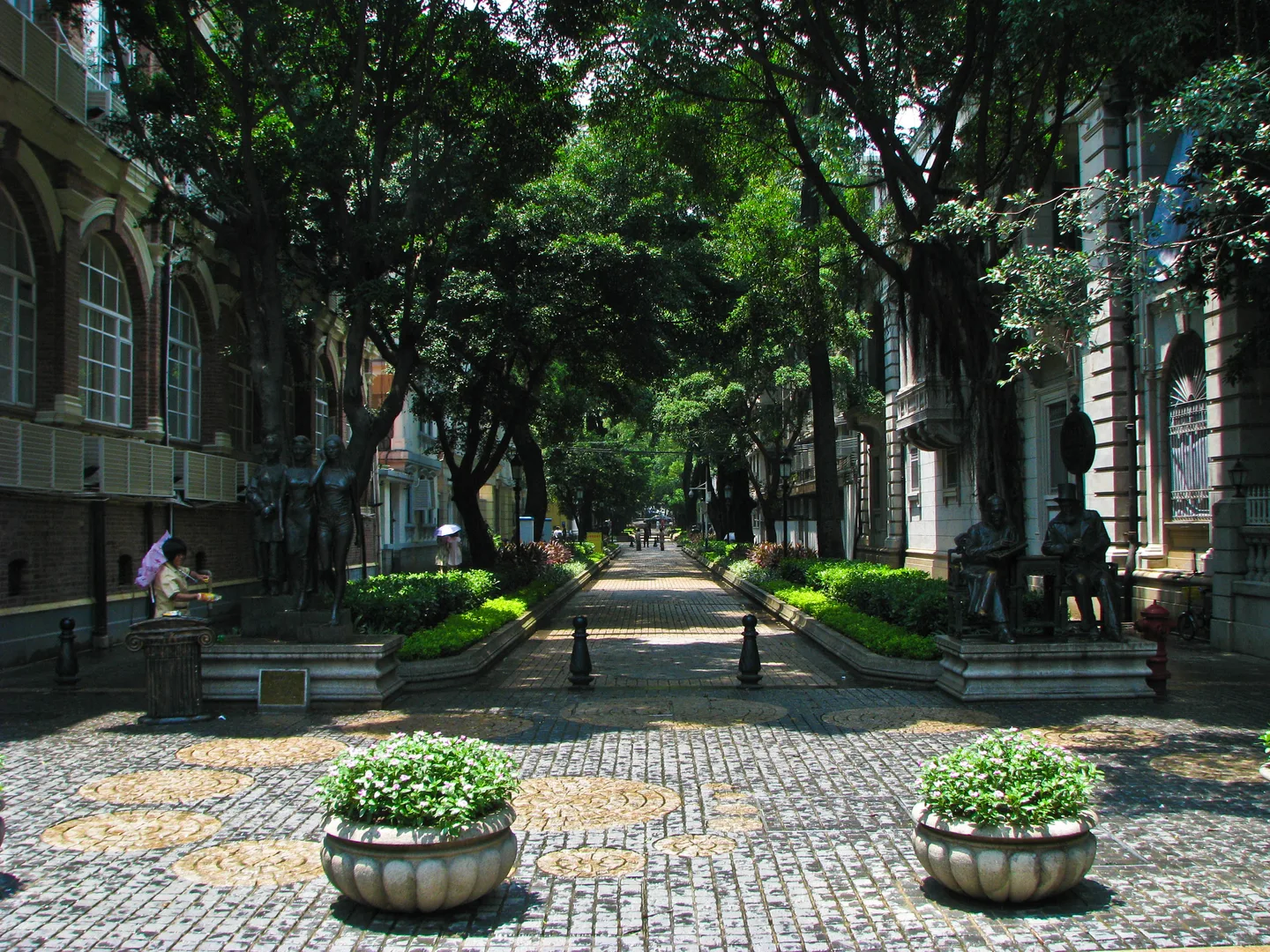 Photo: Eduardo M. C. (2011), CC BY 2.0 — source and license.
5.5 Pazhou and the Canton Fair Complex
Pazhou houses the Canton Fair Complex and other convention venues. Major exhibitions bring international buyers and business travelers, creating opportunities for breakfast, coffee, quick business dining and group meals. However, fair attendance is episodic and should not be treated as daily year-round restaurant demand; check nearby offices, hotels and residents as well.
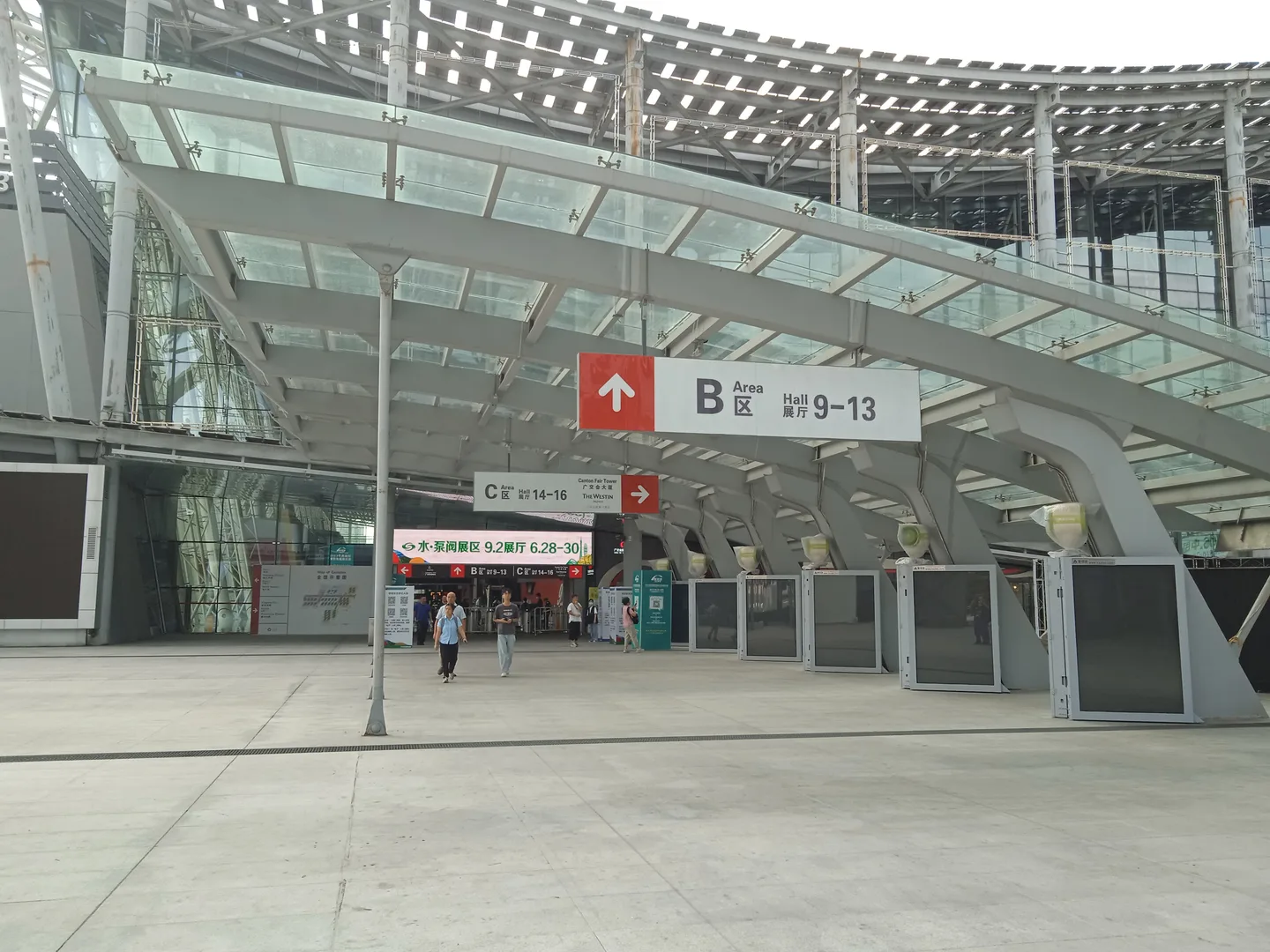 Photo: 中少 (2023), CC BY-SA 4.0 — source and license.
5.6 Party Pier (Zhujiang Pati): Riverside Restaurants and Nightlife
Party Pier (珠江琶醍) is one of Guangzhou's most distinctive restaurant and nightlife settings. A former Pearl River Brewery site has been converted into a riverside leisure district with industrial heritage, outdoor terraces, restaurants, bars and city views. For entrepreneurs considering international dining, social meals or evening concepts, the setting illustrates how the experience and architecture of a destination can be part of a restaurant's proposition. Night-time trade, weather, seasonality and rent still matter.
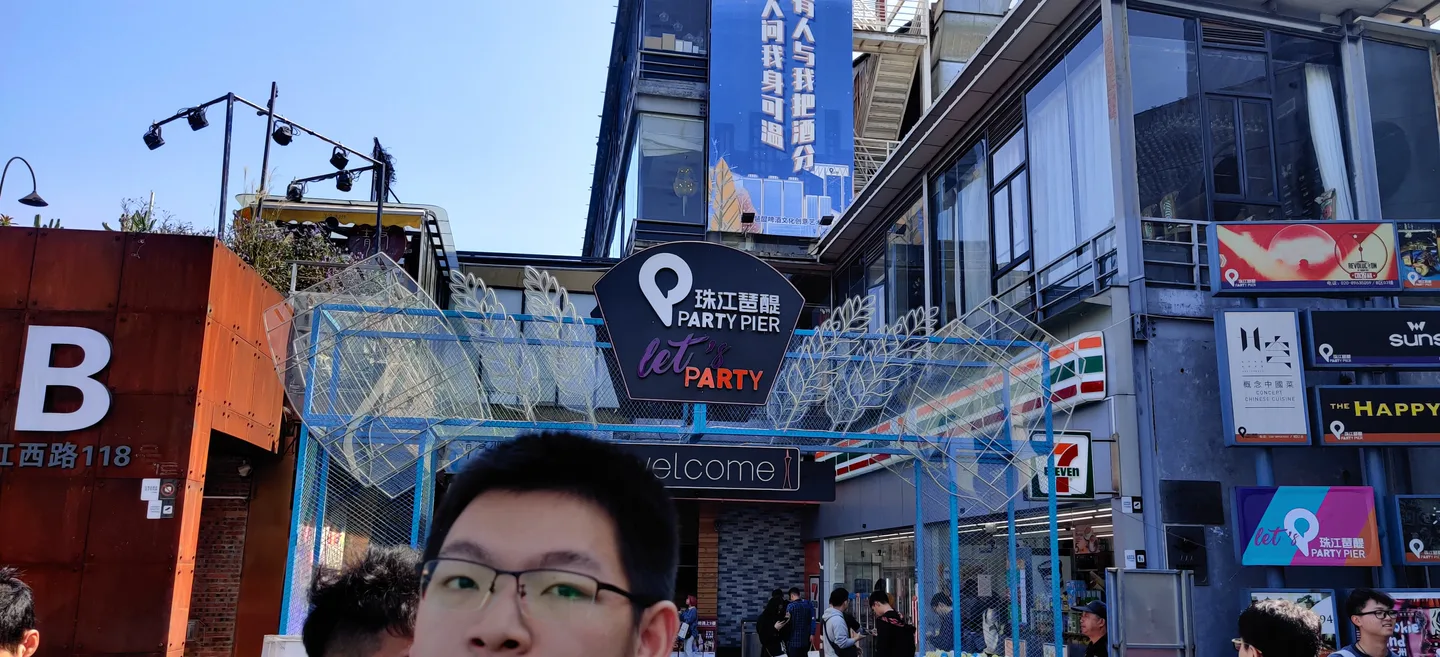 Photo: 橙子木 (2019), CC BY-SA 4.0 — source and license.
Additional real-world editorial photo references (not licensed for automatic republishing): - Party Pier — real riverside dining photograph (Guangzhou municipal planning authority) - Party Pier — open-air dining terrace at night (media reference; permission required for reuse)
6. Practical Considerations Before Signing a Lease
Confirm that the specific premises can legally accommodate your cooking operations; check any special ingredients and import requirements; avoid overdependence on a single foreign chef; negotiate the fit-out rent-free period, exhaust equipment ownership, early termination and management charges; and test the likely mix of local Chinese diners, international business visitors, foreign residents and tourists. An international cuisine does not require exclusively foreign customers.
Sources and Photo Credits
- State Administration for Market Regulation — Food Business License and Filing Measures
- Guangzhou Market Regulation Administration — Guangdong implementation rules
- Guangzhou Ecology and Environment Bureau — restaurant pollution control
- Guangzhou Commerce Bureau — food clusters and business districts
- Canton Fair official site
- CBRE Guangzhou retail-market reports
Photographic assets: Real-place images linked from Wikimedia Commons in Section 5 are credited above with their reuse licenses. Other press/government photographs are listed as reference links only; secure permission before republishing. Photos may show earlier conditions and are not evidence of current tenants.
Image adaptations: photographs resized and converted to WebP. Canton Fair Complex (中少, 2023) and Party Pier entrance (橙子木, 2019) adaptations are licensed under CC BY-SA 4.0. Shamian Island (Eduardo M. C., 2011) is licensed under CC BY 2.0. Source links appear with each photograph. Historical images do not establish current tenant or property conditions.